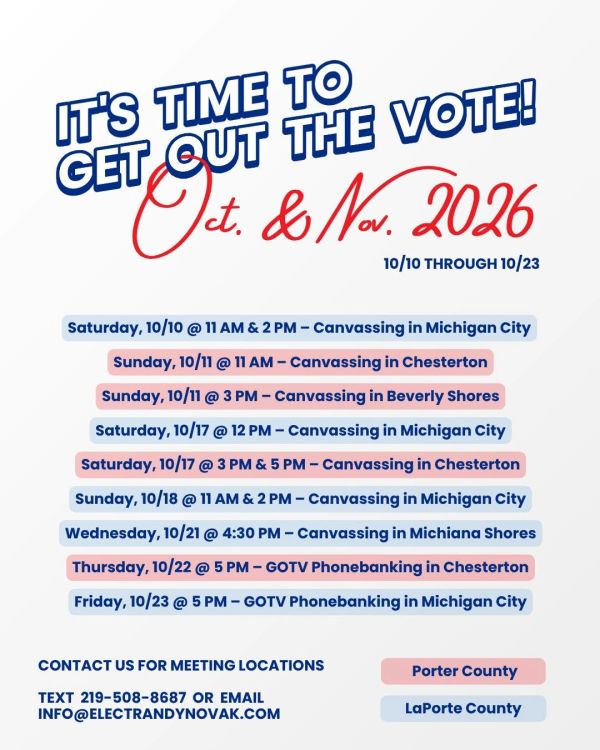
CANVASSING OPPORTUNities


Candidate& Dem Special events

LEGISLATIVE Questions
Please reach us at admin@nastywomenofportercounty.org if you cannot find an answer to your question.
After our admin breakfast this morning , I was asked to draft an explanation on how Bill becomes law in Indiana and make it simple.  . You may ask why? Well, the Indiana general assembly is in session right now and bills have been introduced and there are many that we should be watching. The idea came up that we should know what bills are important to you and we will keep them in on our radar. Then it dawned on us, how do you know what bills are being introduced? So first of all, we thought it best to explain how a bill gets introduced, amended, and then voted on.
1. Idea & Drafting
Everything starts with an idea — usually from a state legislator hearing from constituents, interest groups, or community members. The legislator works with the non-partisan Legislative Services Agency to draft the bill language. 
2. Introduction & First Reading
Once drafted, the bill is formally introduced in either the Indiana House of Representatives or the Indiana Senate — this is called the first reading. Each bill gets a number and is officially entered into the legislative record. 
Once introduced, leadership assigns the bill to a committee based on the subject matter — for example, education, health, or transportation. 
3. Committee Stage
Committees are smaller groups of legislators who specialize in particular policy areas:
• The committee chair schedules hearings.
• Bills may receive public testimony and expert input.
• Members can amend the bill.
• Then the committee votes on whether the bill should move forward. 
If the committee does NOT vote to advance the bill, it dies here. Most bills never make it past this stage. 
4. Second Reading — Floor Debate & Amendments
If the bill passes out of the committee, it returns to the full chamber (House or Senate):
• The bill is placed on the chamber’s calendar for Second Reading.
• During Second Reading, any legislator can offer amendments to change the bill. 
This stage is where broader debate and negotiation among lawmakers happens.
5. Third Reading — Floor Vote in Chamber of Origin
After debate and any amendments, the bill goes to Third Reading — this is the first major floor vote.
• Members debate the final version.
• A majority vote is needed to pass (at least 51 votes in the House or 26 in the Senate). 
If it passes, the bill heads to the other chamber (House → Senate or Senate → House) and the entire process repeats (committee → second reading → third reading). 
⸻
6. If the Second Chamber Amends the Bill
When the second chamber makes changes:
• The bill returns to the original chamber for a concurrence vote. 
• If both chambers agree on the amended bill, it moves forward.
• If not, they may form a conference committee with members from both chambers to negotiate a compromise. 
Once both chambers approve identical language after negotiation, the bill moves on.
7. Governor’s Desk
After both chambers pass the same version:
• The bill goes to the Governor.
• The governor can:
• Sign it — it becomes law.
• Veto it — though the legislature can override a veto with a majority vote.
• Do nothing — and after seven days during session, it automatically becomes law. 
This process exists to ensure thorough discussion and public input — but it also means many bills never make it out of committee or fail to win enough votes
No question is dumb. Feel free to ask somebody else probably has the same question.
Let’s see where we can look up the bills that are currently being reviewed. Here is the website
https://iga.in.gov/legislative/2026/bills
The 2026 bills page on the Indiana General Assembly website shows the list of bills that have been introduced or are active during the 2026 legislative session. As bills are filed by legislators (in the House or Senate), they are added to this list. 
How the list is organized
Once the page loads fully, you’ll typically see:
Bill Number
Each bill has a code like:
• HB1234 = House Bill 1234 (introduced in the Indiana House)
• SB0078 = Senate Bill 78 (introduced in the Indiana Senate)
This number makes it easy to reference or search for a specific bill. 
Short Title/Description
Next to or under the bill number is a short summary — a plain-language description of what the bill is about. This helps you quickly understand the topic before clicking deeper. 
Status or Action
Often bills have a “status” label or a list of actions showing where the bill is in the process (e.g., Introduced, Referred to Committee, Amended, Passed House/Senate). You might not always see all steps on the main list — but individual bill pages will show the history in detail. 
3. How to get more detail on a bill
When you click a bill’s number or title, you’ll go to its detail page, where you can usually find:
Bill Text
This is the full legal wording of the bill as drafted. 
Bill Actions / History
A chronological list of what has happened to the bill — who introduced it, committee referrals, votes, amendments, etc. This tells you how far the bill has progressed. 
Amendments
If legislators changed the bill in committee or on the floor, you can usually find the text of those amendments here. 
4. Tips for using the page
Search tools
• Use the search box or the website’s magnifying glass icon to look up a bill by number or keyword. 
• You can also search by legislator to see bills a particular House member or Senator has authored or co-authored.
Understand status terms
Here’s what you might see:
• Introduced — bill has been filed but not yet debated
• Referred to Committee — bill needs committee review before moving forward
• Passed House/Senate — chamber has voted in favor
• Conference / sent to Governor — final stages before potentially becoming law
What do I do with the info?
• Find your legislators — Use the “Find Your Legislator” tool on the IGA site to contact the people representing you.
• Track hearings & calendars — The site also includes schedules for committee meetings and floor sessions where bills are discussed. 
Summary
Here’s how to read and use the Indiana General Assembly 2026 bills page:
1. Bill numbers (HB/SB) tell you where the bill originated. 
2. Short descriptions give you a quick idea of the topic. 
3. Click into a bill to see full text, status history, and amendments. 
4. Follow the status to understand where the bill is in the process. 
5. Use the search and filter tools on the site to find bills by number, topic, or sponsor. 
Again, there are no dumb questions, don’t hesitate to ask.
Once you begin looking, let us know which bills you want us to be watching.
I will start.
SB 236 makes me furious!!
iga.in.gov
Indiana General Assembly